

Australia's Data Centre Crossroads: Learning from the United States and China Before the Crisis Arrives
26th May 2026
The global proliferation of artificial intelligence has transformed data centres from mundane technical infrastructure into decisive instruments of economic and geopolitical power. Australia now stands at a defining inflection point, possessing both the institutional capacity and the temporal advantage to chart a fundamentally different course from the supply-chain failures plaguing the United States and the authoritarian centralism defining China's approach. Whether Australia seizes this opportunity, or squanders it in pursuit of short-term investment, will determine whether the digital economy becomes an engine of national prosperity or a source of chronic resource vulnerability.
The scale disparity between the world's two largest digital economies is instructive. The United States operates approximately 3,960 data centres, the largest national concentration on earth, while China hosts roughly 365 larger, state-directed hyperscale facilities, a figure that obscures their enormous individual footprints (Cushman & Wakefield, 2026; Visual Capitalist, 2026). Australia, with approximately 250 operational centres and a rapidly expanding approvals pipeline, sits at a volume where decisive early regulation remains both politically achievable and economically rational. The window will not remain open indefinitely. What is already clear is that scale alone does not confer sustainability: the proposed Stratos project in Utah, a single 9-gigawatt facility, would if fully realised consume more electricity than the entire state at peak demand (Utah Clean Energy, 2026). The implicit assumption that energy supply is infinitely elastic has been exposed, in the American context, as a dangerous fiction. Australia must not repeat it.
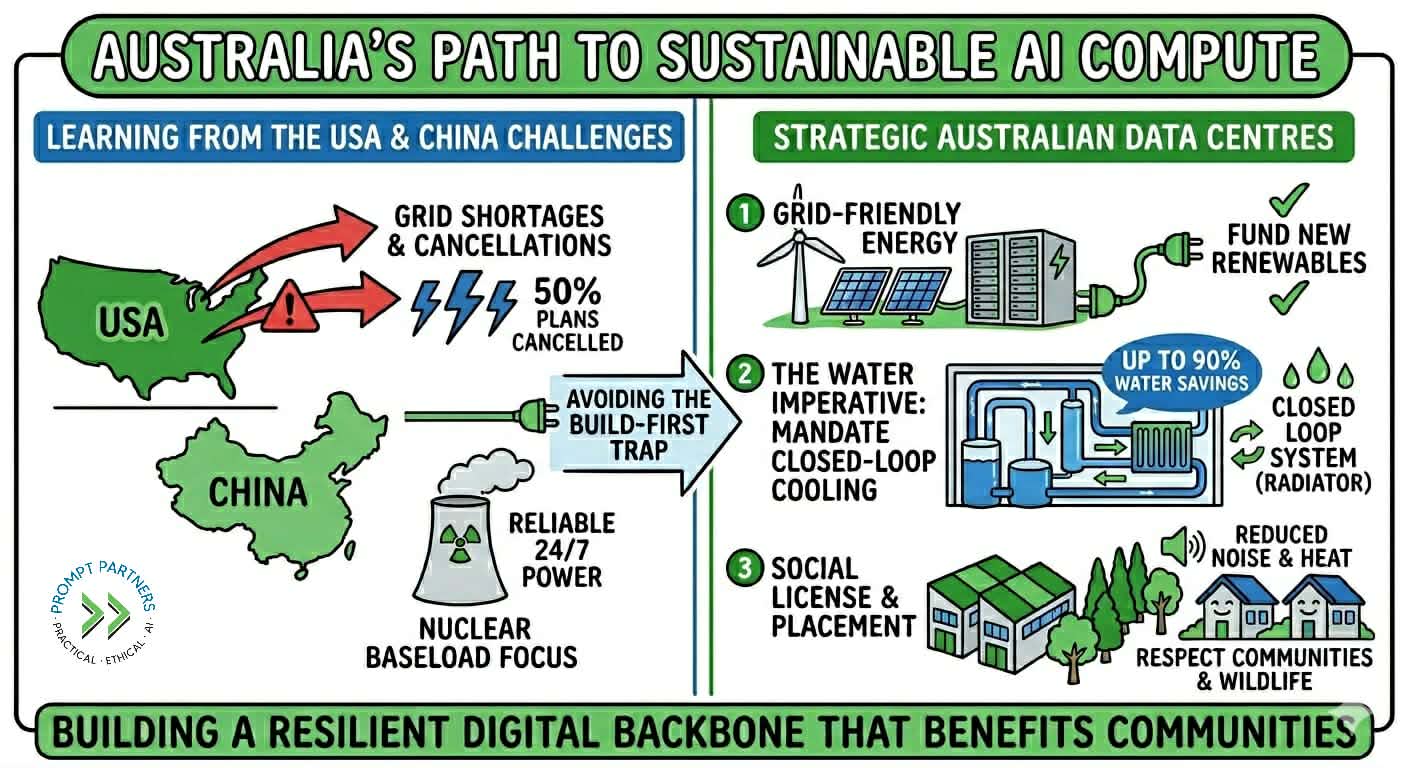
The energy crisis underpinning the United States' AI build-out is not a temporary bottleneck but a structural failure of "build-first" planning doctrine. Supply-chain shortages in high-voltage transformers, grid interconnection backlogs, and the absence of coordinated federal energy policy have resulted in the cancellation or indefinite delay of nearly half of all planned United States data centre projects (Reuters, 2026; TechSpot, 2026). The consequence is a fragmented, stranded-asset landscape in which billions of dollars of committed capital sits idle while residential consumers in affected grid regions face rising electricity prices driven by industrial demand. In the Lake Tahoe region, documented cases of residential load displacement — where household energy access was effectively rationed to accommodate hyperscale data centre contracts — illustrate the equity dimension that purely technical analyses routinely suppress (The Guardian, 2026). China's response to equivalent baseload pressure has been to accelerate a nuclear energy programme explicitly oriented toward data centre demand (World Nuclear Association, 2026). Australia, as the world's third-largest uranium exporter, occupies an ironic position, supplying the fuel that powers China's digital infrastructure while remaining domestically hesitant about nuclear baseload. Whatever position policymakers ultimately take on nuclear power, the lesson is unambiguous: reliable, non-intermittent power is not optional for AI infrastructure, and pretending that the renewable transition alone will supply it on the timelines the industry demands is to indulge a comfortable illusion. Australian regulators must, at minimum, require that new data centre operators directly fund new renewable generation capacity and co-located grid storage, rather than drawing down headroom from existing infrastructure and displacing residential consumers in the process (Herbert Smith Freehills, 2026; SBS News, 2026)
Water, frequently the silent externality in data centre discourse, demands equivalent urgency. Conventional air-cooled and open-loop evaporative cooling systems consume enormous volumes of potable water, and Australia's supply is among the most constrained of any developed economy. Without binding regulatory intervention, these facilities could account for up to 25% of Sydney's drinking water consumption by 2035, a projection that water utilities have advanced on the basis of current approvals trajectories, not worst-case modelling (SBS News, 2026). The engineering solution is well understood: closed-loop cooling systems eliminate the majority of consumptive water loss by recirculating coolant rather than exhausting it through evaporation. The barrier is economic rather than technical, since closed-loop systems cost more to install and are prohibitively expensive to retrofit into existing facilities. This is precisely why mandatory adoption must be applied to new approvals rather than deferred as an aspirational standard. NEXTDC's deployment of closed-loop systems across its Australian portfolio demonstrates that the technology is commercially viable at scale; the remaining question is whether government will require it of all operators or allow the industry to externalise water costs onto urban populations (NEXTDC, 2026). Given Australia's status as the driest inhabited continent, treating water as a free industrial input is poor policy by any measure.
The spatial and social dimensions of data centre placement complete the picture. The United States offers a cautionary case study in what happens when industrial-scale digital infrastructure is sited without binding community impact requirements. The Stratos project in Utah has generated sustained public opposition, in part because its footprint threatens migratory ecosystems adjacent to the Great Salt Lake, ecosystems already under severe hydrological stress (The Guardian, 2026). The pattern of "digital colonisation," in which remote or peri-urban communities bear concentrated environmental costs while diffuse economic benefits accrue elsewhere, is not an American idiosyncrasy but a predictable outcome of planning frameworks that treat community consultation as procedural formality rather than substantive constraint. Australia must embed legally enforceable separation distances, ecological buffer zones, and community benefit-sharing agreements into the primary approval stage, as baseline criteria without which development consent cannot proceed, rather than as conditions imposed after political controversy has already taken hold. Clustering large facilities beside residential areas, schools, or environmentally sensitive habitats without such frameworks is a regulatory failure, and one that the evidence abroad makes entirely foreseeable.
Australia's advantage is temporal as much as geographic or geological. The infrastructure choices embedded in the next five years of approvals will determine the operational parameters of the country's data centre sector for the following three decades. The United States is now attempting, at enormous cost and with considerable political friction, to retrofit sustainability constraints onto a build-out that proceeded without them. China's centralised planning achieves coordination with nuclear baseload power, a project that required foresight and decades-long planning. Australia has the opportunity to demonstrate that a third path is available, one that integrates energy sufficiency mandates, water stewardship requirements, and community protection standards into the approval architecture immediately. Having witnessed the consequences of the alternative in real time, the burden of justification now falls on those who would argue for any other course.
At Prompt Partners, we champion ethical AI investment for Australia.
CITATIONS:
Cushman & Wakefield (2026) — 2026 Global Data Center Market Comparison https://www.cushmanwakefield.com/en/insights/global-data-center-market-comparison
Visual Capitalist (2026) — Mapped: The World's Data Centers by Country https://www.visualcapitalist.com/mapped-countries-with-most-data-centers/
Utah Clean Energy (2026) — Estimated Emissions and Water Consumption from the Proposed Stratos Data Center https://utahcleanenergy.org/estimated-emissions-and-water-consumption-from-the-proposed-stratos-data-center/
SBS News (2026) — Race to Build Australian AI Data Centres Generates Concern https://www.sbs.com.au/news/article/race-to-build-australian-ai-data-centres-generates-concern/2dksgar9r
SBS News (2026) — Amid New Guidelines, a Warning Data Centres Could 'Cut Corners' https://www.sbs.com.au/news/article/new-expectations-in-place-for-resource-hungry-data-centres-coming-to-australia/9cqgj2cdj
Bloomberg / TechRadar (2026) — Nearly Half of US Data Centers Planned for 2026 Canceled or Delayed https://www.techradar.com/pro/if-one-piece-of-your-supply-chain-is-delayed-then-your-whole-project-cant-deliver-nearly-half-of-us-data-centers-planned-for-2026-canceled-or-delayed-and-things-could-soon-get-much-worse
IAEA — The Atom and the Algorithm: Nuclear Energy and AI are Converging https://www.iaea.org/newscenter/statements/the-atom-and-the-algorithm-nuclear-energy-and-ai-are-converging-to-shape-the-future
Herbert Smith Freehills (2025) — Spotlight on Data Centres: The Convergence of Digitalisation and the Energy Transition in Australia https://www.hsfkramer.com/insights/2025-03/the-convergence-of-digitalisation-and-the-energy-transition-in-australia
NEXTDC (2025) — Building the Next Generation of Sovereign AI Infrastructure in Australia https://www.nextdc.com/news/building-the-next-generation-of-sovereign-ai-infrastructure-in-australia
Sierra Club (2026) — Stratos Data Center Approval Threatens Great Salt Lake Basin https://www.sierraclub.org/press-releases/2026/05/stratos-data-center-approval-threatens-great-salt-lake-basin
Grist (2026) — Utah's Fragile Desert Could Feel Like the Sahara if America's Biggest Data Center Gets Built https://grist.org/business/utah-data-center-salt-lake-hyperscale-box-elder/